Astro review 2027: is Astro good for a business website?
 Sharzil AlveFounder, Amani Studio · 7 min read
Our Astro framework review in one line: yes, Astro is good for a business website, and for marketing sites, blogs and docs it's the best way we've found to build one. Our own 43 page studio site runs on it: the homepage scores 100 for speed on Google's PageSpeed Insights, every page builds in under a second, and hosting costs nothing. Here are the real numbers, what it does well, and who it suits.
In short
- Is Astro good? Yes, for marketing sites, blogs, docs and content sites. Our homepage scores 100 for speed on PageSpeed Insights.
- Fast as it grows: all 43 pages of our site build in under a second, and the homepage loads 60 KB of JavaScript.
- Cheap to run: Astro is free and open source, and our hosting on Cloudflare Pages costs nothing.
- Pick something else for an app with logins (Next.js) or a team that wants to redesign pages itself every week (Framer).
Is Astro good? Our verdict
Astro is the best way we've found to build a website that has to load fast and rank: a studio site, a SaaS marketing site, a blog or a docs site. It turns every page into finished HTML before anyone visits, so a visitor's phone has almost nothing left to do.
We don't say that from a demo. On 14 November 2026 we moved our own studio site to Astro, all 35 pages at the time, with every address kept and every page checked against the old one, file by file. Today it has 43 pages and runs on Astro 7.4.4. Here is what that looks like on the live site.
Our numbers on the live site
On 20 November 2026 we put our homepage through PageSpeed Insights, Google's free page test. The homepage carries a showreel video, client logos and the full studio pitch, and it still scored 100.
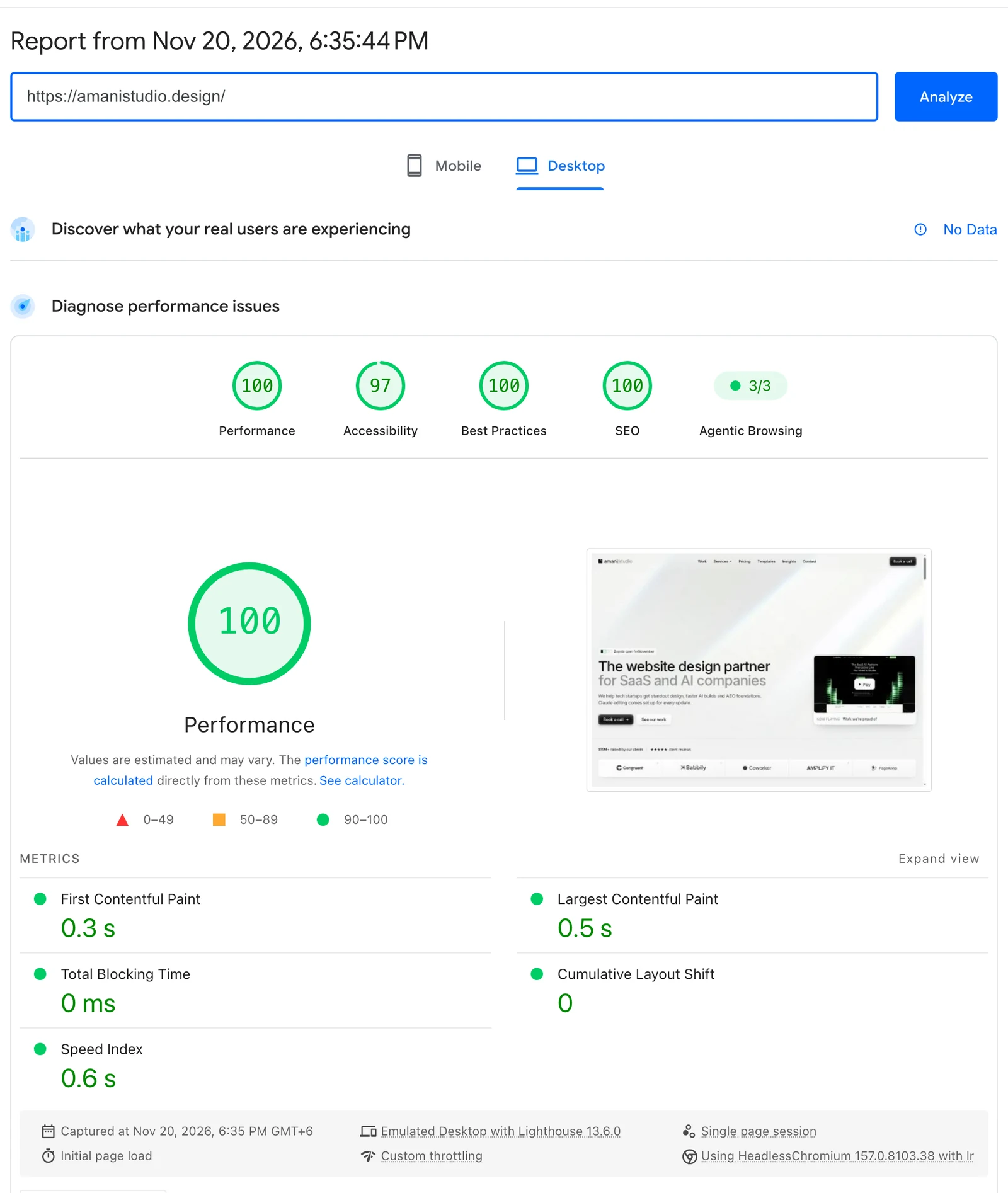
| What we measured | Our site |
|---|---|
| Speed scorePageSpeed Insights, desktop | 100 out of 100 |
| SEO scorePageSpeed Insights | 100 out of 100 |
| First screenLargest contentful paint | 0.5 seconds |
| Jumps while loadingCumulative layout shift | 0 |
| Page weightHomepage, first load | 636 KB, 60 KB of it JavaScript |
| BuildEvery page on the site | 43 pages in under a second |
| HostingCloudflare Pages, free plan | $0 a month |
PageSpeed scores from Google's test on 20 November 2026; page weight measured in Chrome the same day; build time from our own build on a Mac.
Google's targets for Core Web Vitals are under 2.5 seconds for the first screen and under 0.1 for jumps. Our homepage shows its first screen in a fifth of that time and doesn't move at all.

What Astro does well
Speed that stays as the site grows
Most frameworks send the browser code and let the visitor's phone build the page. Astro does that work once, when the site is published, and sends no JavaScript unless a part of the page needs it. On our homepage only the menu, the brief form, the sound on buttons and a few small effects load scripts, 60 KB of JavaScript in all.
The real test is what happens as you add pages. We've grown from 35 to 43 pages since the move, including this blog, and every page still builds in under a second.
SEO and AI answers built in
Search engines and AI tools read plain HTML best, and that's what Astro sends. On our site the same content files make the pages, the sitemap, the FAQ schema and an llms.txt file for AI assistants, so they never fall out of step. Every page title, description and heading is set in code, in one place. If you're on Framer instead, our Framer SEO guide covers the same ground.
Content in plain files
Every post on this blog, this one included, is a Markdown file: words, headings and a few lines of settings at the top. A new post is one new file; the page, the blog card, the sitemap and the FAQ schema follow on their own. Pages are put together from parts, a hero, a pricing table, a case study block, so a new service page reuses what already works instead of starting again.
Hosting that costs nothing
Astro is free and open source under the MIT licence. An Astro site is a folder of plain files, so it can be hosted almost anywhere. Ours runs on Cloudflare Pages, whose free plan allows 500 builds a month, with a copy of the site close to every visitor. Astro's own team joined Cloudflare on 16 January 2026, and Astro stays open source and works with any host.
When not to use Astro
Astro is built for websites where content comes first. Two cases suit something else better.
- An app with logins, dashboards and live data. Next.js is built for that, and you can still run the marketing site in Astro next to it.
- A team that wants to redesign pages itself every week. In Astro, text and posts are easy to change, but new layouts are code. If your marketing team wants to drag sections around on a canvas, Framer fits better; we compare the two in Astro vs Framer for startups.
For everything in between, an Astro site set up well can still be edited by the whole team: we set every site up so a tool like Claude can make text and layout changes safely, and we make them for you if you'd rather not.
Is Astro better than Next.js or React?
For a marketing site, a blog or docs, usually yes: Astro sends finished pages and far less code. For an app, no: Next.js and React are built for screens that change as people use them. Astro isn't a rival to React either; you can use React inside an Astro page for the one part that needs it, such as a pricing calculator.
Astro is also easier to start with. A page is mostly HTML and CSS, so anyone who knows how a web page works can read it. And in October 2026, HTTP Archive found 72.2% of Astro sites passing all three Core Web Vitals on real phones, with Framer close behind at 71.7%.
What does an Astro website cost?
Running it costs very little: Astro is free and hosting can be too, as ours is. The real cost is the build.
- A landing page with us: from $1,999, design and build, with SEO and AEO set up, live in one week.
- A full website with us: from $4,499, six to eight pages and a CMS your team can edit, live in three to four weeks.
- Starting from a template: our Accrue and AgentLab templates also come as Astro code for $149, the same design as their Framer versions.
Our prices are the same whether we build in Astro or Framer, so you pick the tool for the job, not the price.
Want a website that scores like ours?
We design and build fast websites for SaaS and AI startups, in Astro when speed, SEO and owning your code come first. Every site comes with SEO and AI answer setup, and editing your team can do from day one.
See how we build custom websites in Astro, or book a 15 minute call and we'll look at your current site together, including its PageSpeed score.
Sources: Why Astro, Cloudflare Pages limits and PageSpeed Insights, checked 20 November 2026. The scores and page weight are our own tests.